A 99% strike mandate should get people’s attention.
But in Peterborough, Ontario, the most important story may not be the possibility of a strike. It may be why 185 of 187 voting paramedics were prepared to authorize one.
Peterborough City-County Paramedics, represented by CUPE Local 4911, have been bargaining since March. Their concerns include compensation, recruitment, retention, workplace injuries and mental-health benefits. Negotiations are scheduled to resume on October 6.1
This is therefore a labour dispute, and it should be reported as one. But some of the numbers being put forward deserve attention well beyond the bargaining table.
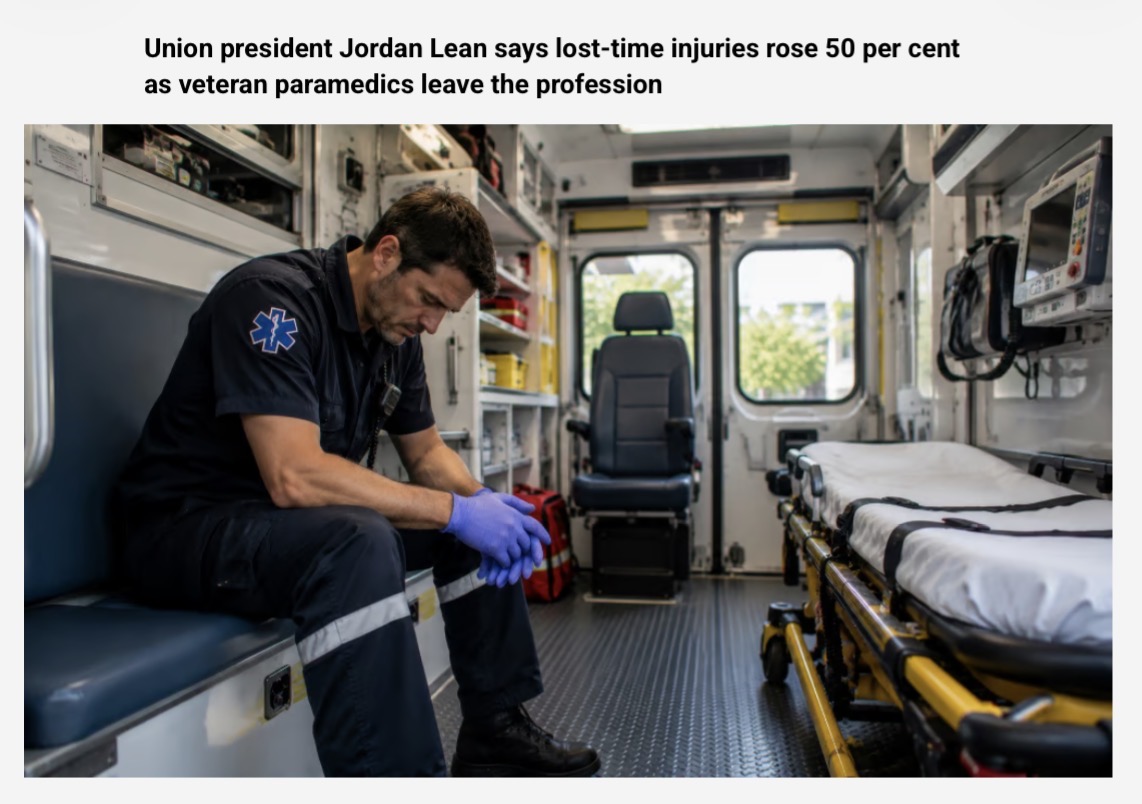
According to CUPE, workplace injuries among its Peterborough paramedic members increased 50% between 2024 and 2025. The union says 14% of full-time paramedics were off work because of workplace injuries in 2025.2
Local 4911 president Jordan Lean told Canadian Occupational Safety that physical injuries and violence contribute to the problem, while lost-time cases are overwhelmingly associated with mental-health issues, including stress leave and PTSD.1
The 50% figure concerns workplace injuries overall; it does not establish a 50% increase in PTSD or psychological injuries alone.
That changes the conversation. When psychological injury removes emergency responders from active service, mental health becomes an operational issue—and ultimately, a public-safety issue.
$500 a year
One number is particularly difficult to ignore.
According to CUPE, full-time Peterborough paramedics currently receive $500 annually in mental-health coverage. The union estimates that buys roughly three sessions with a psychologist or psychotherapist. Part-time paramedics, it says, receive no mental-health benefit.2
Think about that for a moment.
These are professionals whose work can involve catastrophic collisions, suicides, children in medical crisis, fatal overdoses, violence, grieving families and unsuccessful resuscitations. They repeatedly encounter people experiencing some of the worst moments of their lives.
Yet according to their union, the employer-funded psychological benefit available to a full-time paramedic can be exhausted after only a few appointments. For part-time employees, the reported benefit is zero.
If those figures are accurate, we should be asking a much bigger question: What exactly do we mean when we say an organization supports first-responder mental health?
Exposure doesn’t distinguish between full-time and part-time
The distinction involving part-time paramedics is particularly troubling.
Trauma does not check someone’s employment status before affecting them. A part-time paramedic can attend the same suicide, fatal collision, pediatric death, violent patient or unsuccessful resuscitation.
They can experience the same occupational exposure as the full-time paramedic sitting beside them in the ambulance.
Whatever ultimately emerges from collective bargaining, the underlying principle deserves examination: access to appropriate psychological care should reflect occupational exposure and clinical need—not simply employment classification.
The retention numbers should concern everyone
CUPE says 54 full- and part-time paramedics have left the Peterborough service over the past three years, citing increasing call volumes, workplace support and more competitive compensation and benefits elsewhere.4
Earlier this year, roughly 80% of frontline paramedics signed a petition calling for action on staffing, burnout and retention. The union reported approximately 150 open shifts in 2025, with ambulances pulled off the road because of staffing pressures.3
Again, these are union-reported figures and should be tested against employer data. But they should not be dismissed simply because they arise during bargaining.
If experienced paramedics are leaving, vacancies are difficult to fill and occupational injuries are removing others from service, there are consequences.
Remaining employees carry more workload. Overtime can increase. Recovery time can shrink. Experience walks out the door. Newer employees inherit greater responsibility.
An already stressed workforce can become more vulnerable to further psychological and physical injury.
That is how a wellness problem becomes a staffing problem. Then an operational problem. Then a community problem.
Stop treating psychological care as an employee perk
Psychological care for trauma-exposed professions should not be treated like an optional benefit alongside massage therapy or dental coverage.
For police officers, firefighters, paramedics, correctional officers and other repeatedly trauma-exposed professionals, appropriate psychological care should be considered part of the occupational-health infrastructure required to keep the workforce functioning.
We would never knowingly send paramedics into service without appropriate medical equipment. We invest in ambulances, protective equipment, training, communications systems and clinical protocols because those things are necessary to perform the job safely.
Psychological protection deserves the same seriousness.
And benefits alone aren’t enough
Increasing psychological benefits would be positive. But writing a larger number into an insurance plan is not a mental-health strategy.
First-responder organizations need a much broader continuum: preparation before exposure; baseline psychological health information where clinically appropriate and properly protected; early recognition; confidential access to qualified clinicians; peer support; family education; immediate support following significant incidents; evidence-based treatment; meaningful accommodation; recovery; and professionally managed reintegration into the workplace.
Most importantly, employees must trust the system enough to use it.
A $5,000 benefit nobody accesses because they fear career consequences isn’t success either. That is an illustrative example, not a claim about Peterborough’s benefit plan.
Access without psychological safety is not meaningful access.
Measure the cost of doing nothing
Organizations often focus on the cost of expanding mental-health benefits. That is understandable. Public institutions operate with finite resources.
But responsible leadership should calculate the other side of the equation as well.
What does one experienced paramedic leaving cost? What does recruiting and training a replacement cost? What does overtime cost when positions cannot be filled? What does long-term disability cost?
What happens when an experienced responder is away for months with an occupational psychological injury that might have been identified and treated earlier? And what is the operational cost when an ambulance cannot be staffed?
Those numbers belong in the same calculation.
Mental-health investment should not be evaluated only as an expense. It should also be evaluated as workforce preservation. Benefits and savings still need to be measured rather than assumed.
This isn’t about choosing sides at the bargaining table
Beyond Resilience Canada is not in a position to determine what the final Peterborough collective agreement should contain.
There are two parties negotiating, and the employer deserves the opportunity to respond to the union’s claims and present its own data. Canadian Occupational Safety reported that the service had not responded to its request for comment by publication on October 2.1
Compensation, staffing and benefits ultimately have to be resolved through that process.
But there is a principle here that extends far beyond Peterborough. When psychological injury contributes to absenteeism, experienced people leave and emergency-service capacity becomes harder to maintain, organizations cannot continue describing mental health as something separate from operations.
It isn’t.
Psychological health is operational readiness.
The 99% should be the warning
A strike vote does not mean a strike will occur.
The parties are scheduled to return to bargaining on October 6, and there remains an opportunity to reach an agreement.4
But 185 out of 187 voting paramedics saying they are prepared to take job action should be treated as more than a bargaining statistic.
Something is being communicated. The appropriate response is to understand what is behind it.
Verify the injury data. Examine the departures. Measure absenteeism. Assess workloads. Compare psychological benefits. Talk confidentially to the workforce. Determine why experienced people are leaving.
Then address the causes rather than simply managing the consequences.
Canada’s first-responder mental-health problem will not be solved by another awareness campaign telling people that it’s okay to ask for help.
We also have to make sure meaningful help is actually there when they ask.
When psychological injury begins affecting whether emergency vehicles can be staffed, the discussion has moved well beyond wellness.
It has become public safety.
Beyond Resilience Canada
Sources
- Canadian Occupational Safety — Paramedic burnout drives historic strike vote in Peterborough, October 2, 2026
- CUPE Ontario — Peterborough paramedics deliver near-unanimous strike mandate, September 25, 2026
- CUPE — Petition calling for action on paramedic retention, May 12, 2026
- PTBO Today — Peterborough paramedics deliver 99% strike mandate, September 25, 2026