Police accountability matters.
Independent oversight matters.
Public confidence matters.
When police officers engage in misconduct, there must be a credible system capable of investigating what happened and imposing consequences where warranted.
None of that should be negotiable.
But there is another question we don’t ask often enough:
Does accountability have to inflict unnecessary psychological harm on the people going through the process?
Alberta may be taking a small but noteworthy step toward answering that question.
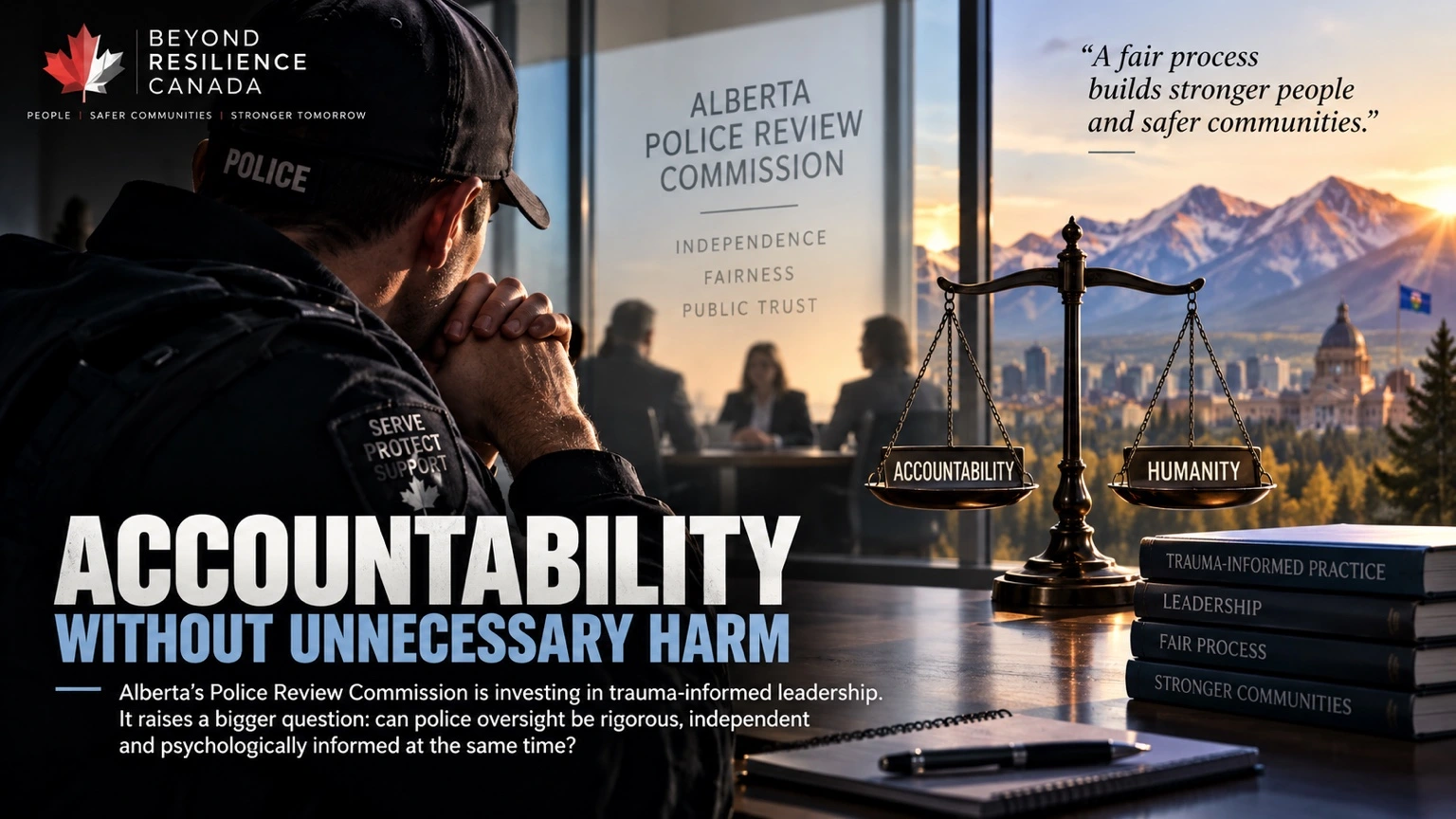
The Government of Alberta has awarded Calgary-based Wayfound Mental Health Group a $15,000 contract to provide “Trauma Informed Leadership Cohorts” to the Police Review Commission, effective October 5.
Fifteen thousand dollars will not transform police oversight.
But the principle behind the investment deserves attention.
Alberta is rebuilding police oversight
The Police Review Commission became operational in December 2025 as Alberta moved toward a single, arm’s-length agency for complaints involving municipal and First Nations police services. ASIRT became part of the PRC on December 1 while retaining its serious-incident investigative role.
The objective is important: strengthen independence, improve public confidence and address the longstanding criticism of “police investigating police.”
But changing who conducts an investigation does not, by itself, guarantee a better process.
How that process is conducted matters too.
PRC planning documents already describe trauma-informed practices when dealing with complainants, including support for people experiencing complex vulnerabilities.
That is significant because police oversight involves people on every side of a complaint—and sometimes those people are already carrying trauma before the investigation begins.
Consider what happens after a critical incident
An officer involved in a fatal encounter can move within minutes from responding to one of the most traumatic events of their career to becoming the subject of an independent investigation.
That investigation may be entirely appropriate.
But while it unfolds, the officer may simultaneously be dealing with the psychological consequences of the incident itself.
There may be uncertainty about their career, restrictions on what they can discuss, public commentary before the facts are established, family stress and potentially months of waiting for resolution.
Accountability is necessary. Unnecessary institutional trauma is not.
Those positions are not contradictory.
Trauma-informed does not mean consequence-free
This distinction is critical.
“Trauma-informed” must never become code for softer investigations, reduced professional standards or insulating police officers from legitimate scrutiny.
If misconduct occurred, trauma does not erase accountability.
If criminal conduct occurred, psychological safety does not replace the justice system.
Trauma-informed oversight means something different.
It means understanding how traumatic exposure and prolonged uncertainty affect people while maintaining clear standards.
It means communicating properly.
Reducing unnecessary delay.
Protecting procedural fairness.
Explaining decisions.
And treating people with dignity.
That is not weaker oversight. It is more professional oversight.
The complainant matters too
This cannot be only about police officers.
People entering a police-complaints process may themselves have experienced violence, fear, discrimination, mental-health challenges, loss or a deeply distressing encounter with authority.
A poorly managed complaints process can compound that experience.
Alberta’s PRC documentation recognizes this, including specialized support intended to help vulnerable complainants meaningfully participate in the process.
That is what genuine trauma-informed oversight should look like.
Not choosing sides.
Designing a process capable of treating everyone involved fairly.
Complainants.
Witnesses.
Families.
Investigators.
And subject officers.
Don’t forget the investigators
People working in serious-incident and police-oversight environments can also face repeated exposure to traumatic material:
Deaths.
Serious injuries.
Body-worn-camera footage.
Interviews with grieving families.
Graphic evidence.
Officers immediately following traumatic incidents.
That exposure accumulates.
If the Police Review Commission is serious about trauma-informed leadership, that philosophy should apply internally as well.
Who supports the people doing the investigating?
That question belongs in the conversation.
Leadership is where this succeeds—or fails
Policies do not create psychologically safe organizations by themselves.
Leaders do.
A policy can require procedural fairness. Leadership determines whether people experience it.
A policy can establish timelines. Leadership determines whether unnecessary delays are tolerated.
A policy can promise confidentiality. Organizational culture determines whether people trust it.
That is why the words “Trauma Informed Leadership” may ultimately be more important than the dollar value attached to the contract.
The challenge is translating training into behaviour.
Don’t just train. Measure.
This is where Beyond Resilience Canada would encourage Alberta to go further.
Don’t simply deliver the training and count attendance.
Measure whether anything changes.
Are investigations completed more efficiently?
Are unnecessary delays reduced?
Do complainants understand what is happening?
Are subject officers kept appropriately informed?
Do participants believe they were treated fairly—even when they disagree with the outcome?
Are investigators receiving appropriate psychological support?
And can Alberta demonstrate that trauma-informed practice improved the process without compromising independence or accountability?
If it can, other Canadian jurisdictions should pay attention.
Psychological safety is tested when things go wrong
Canadian policing increasingly talks about wellness, resilience, peer support, early intervention and psychologically safe workplaces.
Those commitments are easy to make when everything is going well.
Their credibility is tested when something goes wrong.
When a complaint is filed.
When a critical incident occurs.
When an investigation begins.
When someone’s professional future becomes uncertain.
Psychological safety cannot mean avoiding difficult conversations or consequences.
It means those difficult processes are conducted professionally, fairly and without unnecessary harm.
Accountability and psychological safety belong together
For too long, these ideas have sometimes been positioned as opposing philosophies.
They aren’t.
Strong institutions require both.
The public deserves police officers held to high professional standards.
Complainants deserve an independent process in which they can participate meaningfully and be treated with dignity.
Police officers deserve investigations that are impartial, timely and procedurally fair.
Investigators deserve protection from the cumulative psychological effects of their work.
Alberta’s $15,000 investment will not determine whether the Police Review Commission succeeds.
But the philosophy behind it is worth watching.
Because we should never have to choose between holding people accountable and treating them like human beings.
That isn’t softer accountability.
It’s better accountability.
Beyond Resilience Canada